Palette Mixer
The Palette Mixer is Lumi’s space for deriving new colours from the active palette. It treats mixing as a painterly process rather than a simple digital average, so colours can shift, soften, darken, and harmonise in ways that feel closer to physical pigments.
The Mixer works with the palette’s own colour identity. New mixtures are not arbitrary colours pulled from outside the system; they are relationships between colours already present in the palette.
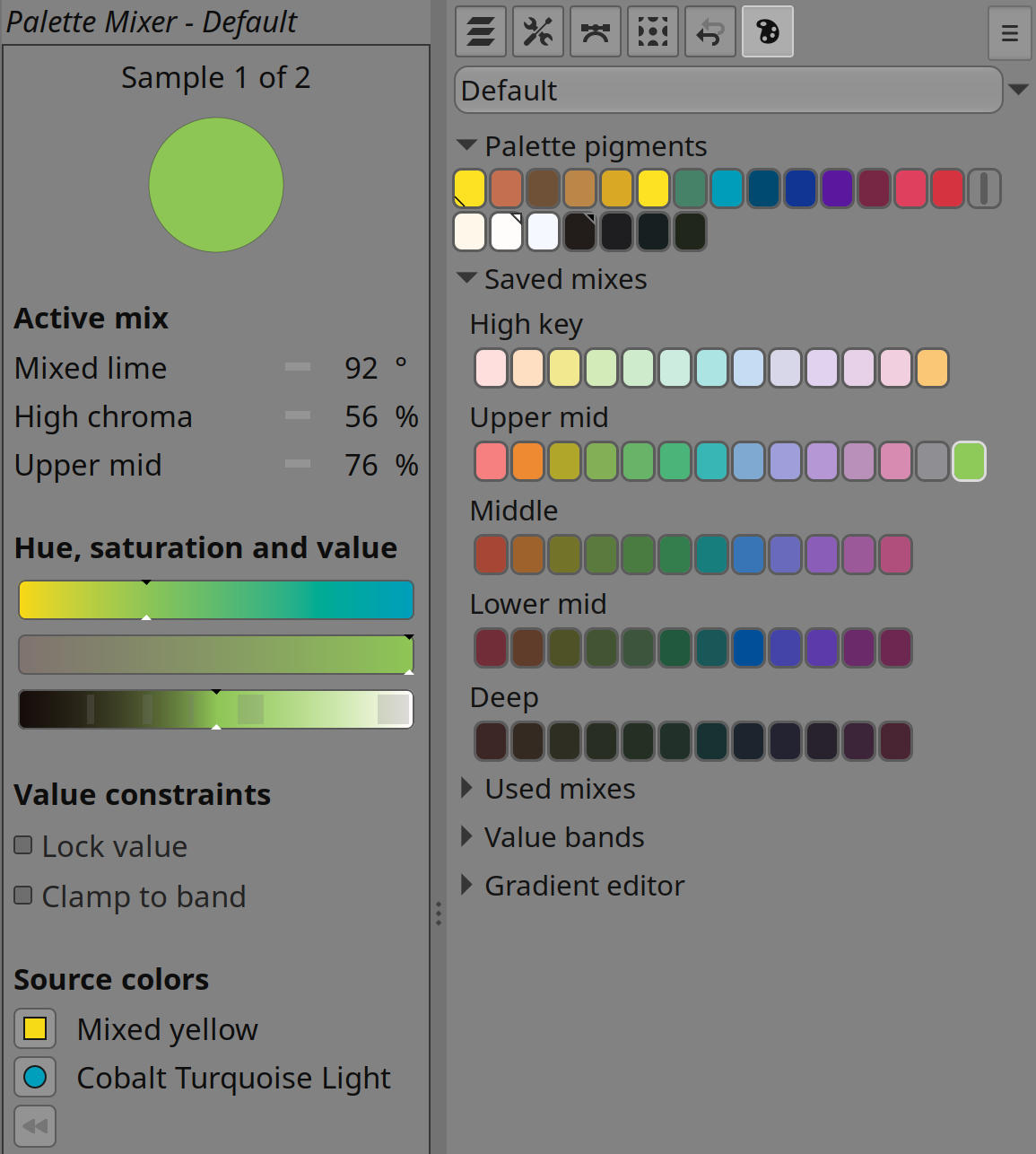
Mixing from palette relationships
A mix begins with source colours from the palette. By moving between them, an artist can explore the passage from one hue family to another while staying inside the palette’s character.
Because the palette is built from pigment-like ingredients, the path between two colours can produce useful intermediate notes: greens from yellows and blues, tempered violets, warm greys, muted earths, or subtle shifts in temperature.
Chroma and tone
The Mixer separates the feeling of a colour into practical painting decisions. A colour can be pushed toward a cleaner or more neutral version, lightened, darkened, or held near a particular value while its hue and saturation are explored.
This makes it easier to search for the colour a painting needs: not only “more red” or “more blue”, but quieter, deeper, paler, warmer, cooler, or more restrained while still belonging to the same palette family.
Saving useful discoveries
When a mixture becomes important, it can become part of the palette. Saved mixes retain their relationship to the colours that produced them, so they can be revisited, adjusted, and reused rather than becoming isolated swatches.
Over time, this lets a palette grow from a set of ingredients into a record of artistic decisions. The useful mixtures from one session can become the starting colours for the next.
A companion to the Palette Map
The Palette Mixer and Palette Map are designed to work together. The map shows the palette as a navigable colour space, while the mixer lets an artist move deliberately between chosen points within that space.
Together they support a workflow that feels closer to mixing paint on a palette: choose neighbouring or contrasting colours, search for the right balance, keep the colours that matter, and continue painting within a coherent colour world.